English
 Español
 Deutsch
 日本語
What a Manual Chain Hoist Is and How It Works
A manual chain hoist is a hand-operated lifting device that raises, lowers and holds loads through a continuous load chain. The operator pulls a hand chain, which turns a wheel connected to a reduction gear train. Because the gears multiply the pulling force, one worker can lift loads that would be impossible to move by hand. The same tool appears in supplier catalogs and engineering drawings under several other names, which is one reason buyers sometimes struggle to compare offers side by side.
Alternative Names in Catalogs and Specifications
The terms chain block, hand chain hoist and chain pulley block all describe essentially the same product. Chain block is the most common shorthand in trade listings, while hand chain hoist is preferred in engineering documents that also list electric hoists. Chain pulley block appears more often in older catalogs and in regions where the device is grouped with pulley equipment. When you write a purchase inquiry, listing two or three of these names together with the rated capacity and lift height reduces the risk of receiving a unit that does not match the application.
The Working Principle
Pulling the hand chain rotates a hand wheel that drives a sprocket. The sprocket engages the load chain, which passes through a set of reduction gears inside the housing. Each gear stage trades speed for force, so a moderate pull on the hand chain produces a much larger lifting force at the hook. A friction brake or pawl system inside the housing holds the load automatically when the hand chain is released. This self-locking action is the most important safety feature of the design, because the load stays suspended without any action from the operator.
Main Components
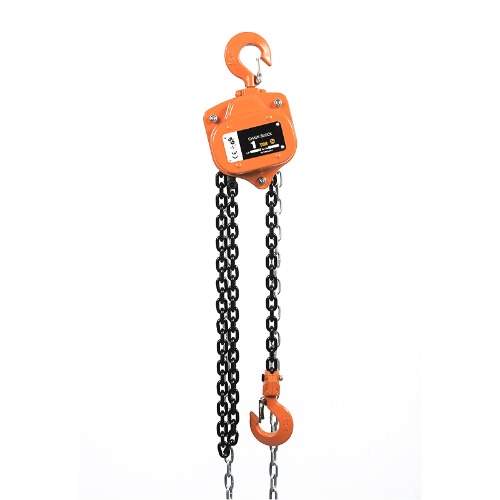
A typical unit is built from a small number of clearly defined parts. Understanding them makes it easier to read specifications and to inspect the hoist before use.
- Upper hook, which attaches the hoist to a beam, trolley or fixed anchor point.
- Housing, which encloses the gear train and brake and protects them from dust and impact.
- Gear assembly, which provides the mechanical advantage that makes manual lifting practical.
- Load chain, a calibrated alloy chain that runs over the load sprocket.
- Lower hook, fitted with a safety latch to prevent accidental disengagement.
- Hand chain, the loop pulled by the operator to drive the lifting action.
Why Buyers Choose a Chain Block Over Powered Equipment
Electric hoists are fast and convenient, yet they are not always the right choice. A manual unit needs no electrical supply, no control wiring and no compressed air. It can be installed on a temporary beam, moved to another bay in minutes, and used during a power outage or in areas where electrical equipment is restricted. For many procurement teams, the lower purchase price and the absence of electrical maintenance make the manual option the more economical one over the life of the equipment.
Operates anywhere a worker can stand and pull.
Holds the load without operator input when released.
Fits tight headroom and narrow aisles.
The table below summarizes the main differences between a manual chain hoist and a typical electric chain hoist. It is a useful starting point when your project team is deciding which type fits the job.
| Criteria | Manual Chain Hoist | Electric Chain Hoist |
|---|---|---|
| Power source | None required | Electrical supply needed |
| Initial cost | Lower | Higher |
| Lifting speed | Slow and controlled | Fast and continuous |
| Portability | Very high | Moderate |
| Routine maintenance | Minimal | Motor and controls |
| Best for | Occasional or precise lifts | High-frequency production lifting |
The slower operating speed is often an advantage rather than a drawback. Precise positioning of machine parts, delicate loads and assembly work all benefit from the hand-controlled pace of a manual unit, because the operator can feel the load and stop instantly.
Typical Applications Across Industries
Manual chain hoists are used wherever lifting is needed but a permanent powered installation is not justified. The following applications account for a large share of purchase orders received by equipment suppliers, and each one places slightly different demands on the hoist.
Industrial Workshop Equipment Installation and Maintenance
Machine shops and assembly plants use chain blocks to lift motors, gearboxes, pump housings and dies during installation and overhaul. Because these tasks occur irregularly, a hoist that can be suspended from an existing beam or a portable tripod is more practical than a fixed electric system. Maintenance teams often keep one or two units in the tool crib specifically for emergency removal of heavy components.
Construction Site Material Lifting
On building sites, a manual hoist can raise steel sections, formwork panels and bundles of reinforcing bar to a limited working height. It is commonly rigged from a scaffold tower, a steel frame or a temporary gantry. Contractors value the unit for its ability to operate without generator power, which is important in early construction phases when site electricity may not yet be connected.
Warehouse and Logistics Cargo Handling
In warehouses, chain blocks are used for loading heavy pallets onto trucks, positioning drums and adjusting equipment in narrow aisles. A typical case involves a two-ton unit mounted on a monorail trolley, allowing one operator to reposition goods across a bay without moving a forklift. The compact body keeps headroom clearance adequate in low-ceiling storage areas.
Marine, Vehicle Repair and Emergency Lifting
Ship repair yards, automotive workshops and offshore maintenance crews rely on manual hoists for tasks that take place far from a power outlet. Engine removal, deck equipment servicing and recovery operations are typical examples. In these environments, the rugged housing and the ability to operate in damp or dusty conditions are key selection criteria.
Core Specifications to Check Before Buying a Chain Block
Procurement decisions are most reliable when they are based on a short list of verifiable specifications. The four items below should appear on every quotation request, and they are the first points that engineering reviewers check.
Rated Lifting Capacity
The rated capacity is the maximum load the hoist is designed to lift safely under normal conditions. Common models are offered in 0.5, 1, 2, 3, 5 and 10 ton capacities. Always select a capacity that exceeds the heaviest load you expect, including slings, spreaders and any attachments, because these add weight that is often overlooked during planning.
| Rated Capacity | Typical Application | Common Usage Setting |
|---|---|---|
| 1 ton | Machine parts and small motors | Workshops and maintenance bays |
| 2 ton | Gearboxes and pump assemblies | Factories and warehouses |
| 3 ton | Heavy fixtures and die sets | Production lines |
| 5 ton | Steel sections and large castings | Construction and fabrication |
| 10 ton | Heavy machinery and structural parts | Heavy industry and shipyards |
Standard Lifting Height
Lifting height is the vertical distance the hook can travel from its highest to its lowest position. Standard chain lengths commonly range from 3 to 10 meters, and longer lengths can be supplied for deep pits or multi-level work. Measure the vertical distance from the anchor point to the lowest floor level and add a margin for slinging. Remember that a longer chain adds weight to the unit and increases the time needed to lower and raise loads, so do not specify more height than the job requires.
Load Chain Grade and Material
The load chain is the most critical component of the hoist. Grade 80 alloy steel chain, often written as G80, is widely specified in international trade because it offers a high strength-to-weight ratio and reliable fatigue performance. When reviewing a quotation, confirm the chain grade, the nominal diameter and the material certificate. Ask the supplier to state the proof load and breaking load of the chain, since these values give a clearer picture of real safety margins than the rated capacity alone.
Tip: Request a test certificate for each batch of load chain. A traceable certificate allows your quality department to verify the material source and heat treatment if an audit is required later.
Safety Certifications and Working Environment
Ask for documented conformity with recognized standards, such as CE marking for European projects, and check whether the supplier provides a load test report for each unit. For outdoor or humid environments, specify surface treatment and housing protection, such as a corrosion-resistant coating. Indoor units can use standard finishes, but dusty plants may require sealed covers on the gear housing to keep abrasive particles away from the brake.
How to Select the Right Chain Pulley Block
Choosing a hoist is easier when the decision follows a logical order. Starting with the load and ending with the safety features prevents the common mistake of selecting a unit that is strong enough but cannot physically fit the workplace.
Confirm the Actual Lifting Load
Weigh the heaviest item if possible, or obtain its shipping weight from the manufacturer. Add the weight of slings, spreader beams and lifting accessories. Then select a hoist whose rated capacity is comfortably above this total. Avoid choosing a hoist that is rated exactly at the load, because repeated use at the limit accelerates wear on the brake and chain.
Measure the Required Lifting Height
Determine the highest point the hook must reach and the lowest point it must descend to. If the lift takes place over a pit, a machine bed or a truck bed, include that depth. A commonly overlooked detail is the height of the load itself, because the hook must clear the top of the load before it can be lowered.
Consider Working Space and Mounting Conditions
Check the headroom, the width of the travel path and the strength of the mounting point. A beam or hanger must be rated to carry the full load plus the dynamic effect of lifting. For trolley-mounted units, confirm that the flange width of the monorail matches the trolley. Where space is tight, a compact body and a short upper hook can make the difference between a feasible installation and one that requires structural modification.
Check Safety Features
Look for a safety latch on every hook, a load brake that engages automatically, and an anti-drop device on the hand chain mechanism. Confirm whether the lower hook can swivel, since swivel hooks reduce twisting of the load chain. These features do not add much to the purchase price but significantly reduce the risk of accidents during routine work.
Safe Operation and Maintenance of Hand Chain Hoists
Most hoist failures in service are caused by avoidable conditions such as overloading, side pulling, worn chain or damaged hooks. A short set of rules, followed consistently, prevents the majority of these incidents and extends the service life of the equipment.
Practices to Follow During Lifting
- Confirm the load is within the rated capacity before every lift.
- Pull the hand chain straight and at a steady pace, never with jerking motions.
- Keep hands and body clear of the load path and the hook travel zone.
- Secure the load properly with slings or fixtures before lifting.
Practices to Avoid
- Do not use the hoist for side pulling or dragging loads across the floor.
- Do not stand under a suspended load or allow others to do so.
- Do not operate a hoist with a visibly damaged hook, latch or chain.
- Do not use an extension on the hand chain to increase pulling force.
Regular Inspection Checklist
Inspect the unit before each shift for chain wear, deformation, rust, cracked welds and proper latch operation. Once a month, check the brake function by lifting a light load and confirming that the load holds when the chain is released. Record each inspection and remove any hoist from service until repairs are completed and tested.
Load chains should be replaced when elongation or wear exceeds the limits stated by the manufacturer. Do not attempt to repair a worn load chain by welding or straightening it.
Storage to Prevent Rust and Chain Damage
Store the hoist in a dry area, lightly coated with a rust-preventive oil on the load chain. Hang it so that the chain does not kink or rest under tension for long periods. Keep the unit off the floor in a clean rack, and protect it from chemicals and salt spray where possible.
Manual Chain Hoist vs Lever Hoist: Understanding the Difference
Buyers often compare a chain block with a lever hoist, sometimes called a lever block or come-along. Both are manual devices, but they operate on different principles and suit different tasks. Confusing them can lead to an unsuitable purchase, so it is worth reviewing the differences before the order is placed.
| Feature | Manual Chain Hoist | Lever Hoist |
|---|---|---|
| Operating method | Pull the hand chain | Push and pull a lever handle |
| Typical lift direction | Vertical lifting | Horizontal pulling and tensioning |
| Lifting height | Long vertical travel | Short travel per stroke |
| Best use | Lifting loads from above | Positioning, tightening and securing |
| Space needed | Vertical clearance | Compact in tight spaces |
In practice, the chain hoist is the correct choice whenever the load must be raised or lowered over a significant height. The lever hoist is more appropriate for pulling objects horizontally, tensioning cables or making small adjustments. Some workshops keep both types in stock so that the right tool is available for each task.
Practical Notes for Project Buyers
Engineering teams and purchasing managers who buy chain blocks in batches should consider several practical points beyond the basic specification. Standardizing on one or two capacities simplifies spare parts management and operator training. Ask whether the supplier can provide custom lifting heights, special hook types or painted finishes to match a plant color scheme. Request a full packing list with each shipment, including chain length, hook sizes and any accessories, so that receiving inspection can be completed quickly.
For larger projects, it is helpful to prepare a short technical request that lists the rated capacity, lift height, mounting method, operating environment and required certifications. A clear request allows the supplier to quote accurately, reduces the number of clarification rounds and helps the project team plan delivery and installation with confidence.
Frequently Asked Questions About Manual Chain Blocks
Q1: What is another name for manual chain hoist?
Manual chain hoist is also known as chain block, hand chain hoist and chain pulley block. These names refer to the same hand-operated lifting device that uses a load chain and a hand chain.
Q2: Can a chain block be used horizontally?
A chain block is designed primarily for vertical lifting. It can be used for limited horizontal movement when mounted on a trolley, but pulling the load sideways with the hook is not recommended because it stresses the housing, chain and brake.
Q3: How long is the standard lifting chain of a hand chain hoist?
Standard lifting chain lengths commonly range from 3 to 10 meters. Longer lengths can be supplied on request for deep pits or multi-level work, but the lifting speed and the weight of the unit should be considered when choosing a longer chain.
Q4: What chain grade is used on industrial manual chain hoists?
Grade 80 alloy steel chain, usually written as G80, is widely used on industrial manual chain hoists. It offers high strength and good fatigue resistance. Buyers should request material certificates and proof and breaking load values to confirm the chain grade.
Q5: Is a manual chain hoist suitable for continuous heavy lifting?
Manual chain hoists are best suited to occasional or intermittent lifting. Continuous heavy lifting places sustained physical demand on the operator and accelerates wear on the gears and brake. For high-frequency production lifting, a powered hoist is usually more efficient.