English
 Español
 Deutsch
 日本語
日本語Understanding the Foundation of DIN Standard Wire Rope
Engineers who specify rigging hardware for European-engineered equipment, or for international projects that reference German norms, quickly encounter the term DIN standard wire rope. The phrase refers to steel wire rope manufactured to dimensional, construction and strength requirements published under the Deutsches Institut fur Normung, the German standards body. Those requirements define everything from the number of wires in each strand to the tolerance allowed on rope diameter, giving buyers a shared language when comparing products from different mills.
Because the standards describe construction rather than brand, a DIN-referenced rope can be evaluated on measurable criteria: lay type, core material, nominal diameter, minimum breaking force and surface finish. This makes procurement more predictable, especially for projects that must satisfy inspection authorities in several countries at once.
How DIN Standard Numbers Organize Wire Rope Families
Reading the Numbering System
Each DIN number identifies a specific rope family. The first part of a designation typically reflects the standard's scope, while the later digits correspond to the strand count and wire count per strand. Understanding this pattern helps buyers move quickly from a drawing callout to a rope that will perform as intended.
Common Standards in Everyday Use
- DIN 3052 covers single-strand ropes with a simple, stiff construction suited to guying and fixed rigging.
- DIN 3053 describes 1x19 ropes that resist kinking and are often used for controls and safety cables.
- DIN 3055 covers 6-strand ropes with 7 wires per strand, providing good flexibility for general lifting.
- DIN 3060 describes 6x19 constructions, the workhorse family for cranes, hoists and winches.
- DIN 3064 covers 6x36 ropes, which offer higher flexibility and fatigue resistance on sheaves of modest diameter.
Core Strengths That Matter in Engineering Specifications
Specifying DIN standard wire rope brings several practical advantages. Dimensional consistency means that terminations, sheaves and drum grooves designed for one batch will accept the next without modification. Strength values are derived from tested minimum breaking forces, so a safety factor can be calculated from published data rather than estimated.
Galvanized surfaces extend service life in humid, coastal or industrial atmospheres. A zinc coating protects the steel both by forming a physical barrier and by sacrificing itself when the surface is scratched, which is why coating class is a meaningful selection parameter.
Main Types of DIN Standard Wire Rope and Their Typical Uses
The range of available constructions is wide, but most projects can be served by a handful of families. The table below summarizes the most frequently specified options and the core filling choice for each.
| Standard | Construction | Core Type | Typical Diameter Range | Primary Use |
|---|---|---|---|---|
| DIN 3052 | 1x7 | Single strand | 1 to 8 mm | Guying and fixed rigging |
| DIN 3053 | 1x19 | Single strand | 1 to 6 mm | Controls and safety cable |
| DIN 3055 | 6x7 | Fiber core | 4 to 30 mm | General lifting and haulage |
| DIN 3060 | 6x19 | Fiber or IWRC | 6 to 60 mm | Cranes, hoists, winches |
| DIN 3064 | 6x36 | Fiber or IWRC | 8 to 60 mm | Flexible lifting on small sheaves |
Single-Strand Constructions
Single-strand ropes consist of wires laid in one layer around a central wire. They are stiff, resist elongation and handle static loads well, which explains their use in guy lines and anchorage applications where flexibility is not required.
Six-Strand Constructions
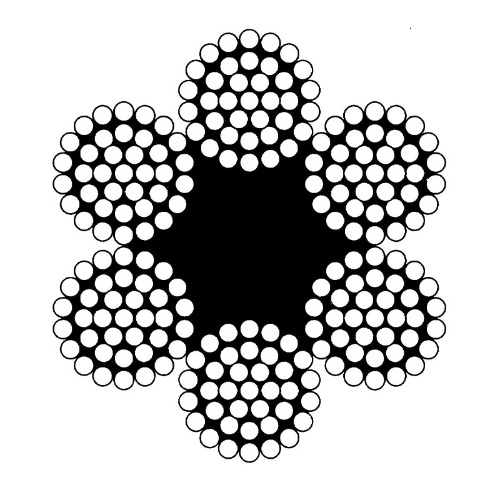
Six-strand ropes wrap six strands around a core, and the wire count per strand determines the balance between flexibility and abrasion resistance. Fewer, thicker wires per strand resist abrasion better, while more, finer wires bend more easily around sheaves.
Eight-Strand Constructions
Eight-strand designs are less common in general rigging but appear in specialized applications where torque balance and a smooth outer surface are valued. They require careful end termination to maintain their geometry.
Surface Finishes
- Galvanized: the default choice for outdoor, marine and construction use.
- Bright (ungalvanized): used where the rope will be lubricated or kept indoors.
- PVC or PE coated: chosen to protect the rope from abrasion, to improve grip on drums, or to reduce noise and corrosion in sensitive environments.
Technical Parameters That Drive Selection
Selecting a rope is an exercise in matching construction to duty. Engineers typically work through four parameters before settling on a specification.
Core Material: Fiber Core Versus Steel Core
A fiber core offers flexibility and lubricant retention, making it suitable for most general lifting. A steel core, often called IWRC, adds crush resistance and supports higher loads, which is why it is preferred for heavy crane work and high-temperature environments.
Tensile Strength Grades
Rope strength is expressed as a grade of wire tensile strength. Higher grades allow a smaller diameter for the same breaking force, which saves weight and space, though they may be less tolerant of bending fatigue and shock loading.
Diameter Tolerance and Coating Class
Nominal diameter is always measured within a permitted tolerance, and that tolerance affects how well the rope seats in sheave grooves. Coating class describes the mass of zinc applied per square meter, and a heavier coating gives longer protection in aggressive atmospheres.
Breaking Load and Working Load Limit
The minimum breaking force is the strength the rope must meet in a test. The working load limit is obtained by dividing that figure by the design factor required by the application and the governing code. Using the breaking force as a working value is a common and dangerous mistake.
Where DIN Standard Wire Rope Performs Best
The same rope family can serve very different industries, but each environment places its own demands on the product.
Construction and Tower Crane Lifting
Crane ropes must tolerate repeated bending over sheaves while carrying heavy loads. Six-strand 6x19 and 6x36 constructions are commonly chosen, with regular inspection schedules tied to hours of operation and observed wear.
Marine and Offshore Rigging
Saltwater accelerates corrosion, so galvanized or specially coated ropes are standard. Ship lashing, mooring and deck equipment all benefit from rope that maintains strength after prolonged exposure to spray and humidity.
Mining and Heavy Industry
Haulage and hoisting in mines expose rope to abrasion, shock and dust. Ropes with heavier outer wires and steel cores tend to last longer under these conditions.
General Rigging and Safety Systems
Guy wires, fall-arrest lines and safety cables often use single-strand or 1x19 constructions because their stiffness and predictable elongation simplify installation and tensioning.
- Define the maximum static and dynamic load on the rope.
- Identify the environment, including temperature, moisture and chemical exposure.
- Choose the construction and surface finish that match those conditions.
- Confirm the design factor and inspection interval with the governing code.
Selecting and Sourcing DIN Standard Wire Rope from Suppliers
A reliable procurement process starts with a complete specification. Buyers who share the standard number, construction, nominal diameter, surface treatment and quantity with their supplier typically receive accurate quotations faster and avoid substitutions that can compromise safety.
Documentation to Request
Mill test certificates confirm the chemical composition and mechanical properties of the wire. Dimensional reports and galvanizing certificates provide additional assurance that the rope meets its declared class.
Factors That Influence Lead Time and Cost
Diameter, length, coating type and order quantity all affect production planning. Custom lengths with terminations usually require additional handling, so clear requirements at the start of a project reduce delays.
Ready to specify your rope? Send your standard number, construction, diameter, surface finish and quantity to our team, and request a quotation tailored to your project.
Request a quotationFrequently Asked Questions About DIN Standard Wire Rope
Q1: What is the difference between DIN and EN wire rope standards?
DIN designations are the original German norms, while EN standards are European harmonized versions that often replace them. Dimensions and strength values are generally aligned, but buyers should confirm which edition a project references.
Q2: Can DIN standard wire rope be supplied galvanized or coated?
Yes. Galvanized, bright and PVC or PE coated finishes are all common, and the right choice depends on the corrosion risk and handling requirements of the application.
Q3: What factors affect the price of DIN standard wire rope?
Construction type, nominal diameter, core material, galvanizing class, order quantity and required certificates all influence cost. Providing complete specifications helps suppliers quote accurately.
Q4: Is a 6x19 with an IWRC core suitable for heavy lifting?
A 6x19 construction with an independent wire rope core is widely used for heavy lifting because the steel core supports crush resistance and load capacity, making it a common choice for demanding duty.
Q5: Which documents should be requested with a rope order?
Buyers commonly request mill test certificates, dimensional inspection reports and galvanizing certificates. These documents support traceability and help satisfy project inspection requirements.
Extending the Service Life of Galvanized Wire Rope
Even the best rope will deteriorate without proper care. Regular visual inspection for broken wires, flattening, corrosion and kinks is the first line of defense. Lubrication suited to the environment reduces internal friction and slows corrosion, and storing rope off the ground in a dry area prevents early damage. Replacing rope on a schedule based on inspection findings, rather than waiting for failure, is the most reliable way to maintain safe operation.