English
 Español
 Deutsch
 日本語
日本語The Right Chain Starts with the Right Grade—Here’s Your Answer
For load binding, towing, logging, and marine applications, G43 high test chain is the optimal mid-strength choice when Grade 30 proof coil is insufficient but Grade 70 or Grade 80 alloy chain would be overkill or misapplied. However, G43 chain must never be used for overhead lifting—that requires Grade 80 or higher alloy chain. The selection process boils down to four factors: working load limit (WLL), chain diameter, finish/environment, and application type. Get these right, and your G43 chain will deliver safe, reliable service for years.
What Exactly Is G43 High Test Chain?
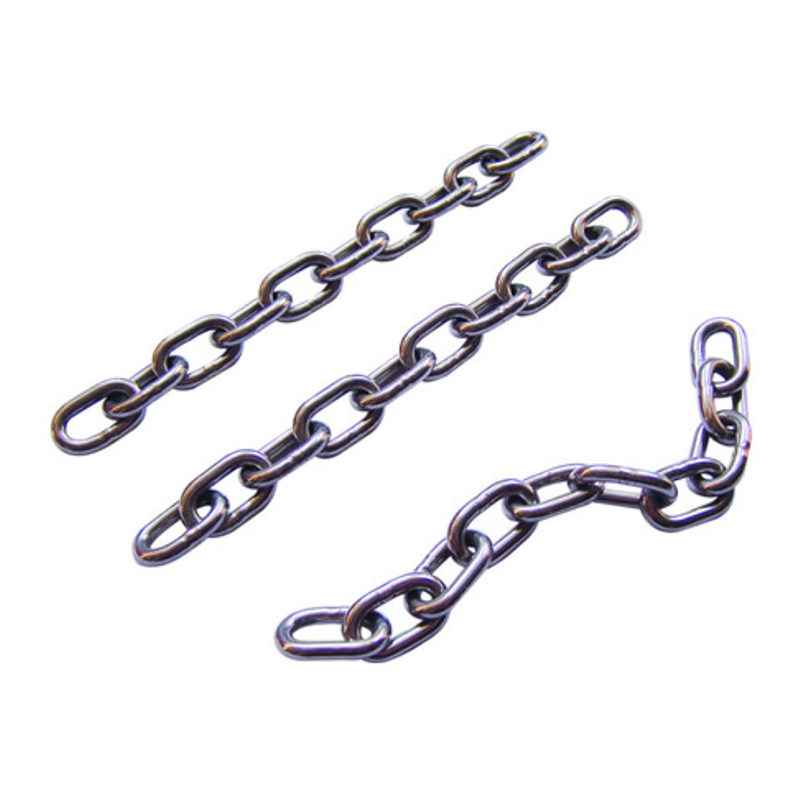
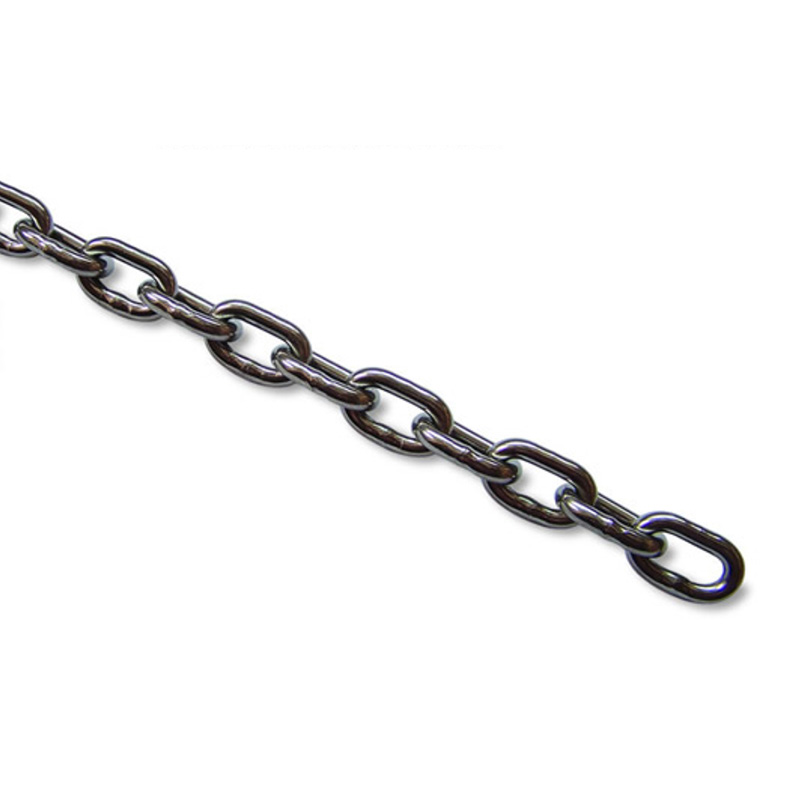
G43 chain—also called High Test chain—is a carbon steel welded chain manufactured to meet ASTM A413 and NACM specifications. The "43" in its name refers to its minimum tensile strength of 43,800 pounds per square inch. It is heat-treated to provide enhanced strength and durability compared to lower-grade chains like G30.
The term "High Test" means the chain is proof tested to twice its working load limit—a quality control measure that verifies weld and material integrity. Every foot of G43 chain undergoes this proof testing before it leaves the manufacturer.
Step-by-Step: How to Select the Right G43 Chain
Step 1: Determine Your Working Load Limit (WLL) Requirement
The WLL is the maximum load the chain should ever be subjected to in daily use. Never exceed the WLL—this is the single most critical rule in chain selection. Common G43 chain sizes and their WLLs include:
Based on standard G43 chain specifications.
Step 2: Match the Chain to Your Application
G43 chain is designed for specific applications. It is not a general-purpose chain for every scenario. Typical uses include:
- Load binding and cargo securement—securing loads on trucks and trailers
- Towing and lashing—vehicle towing and load lashing applications
- Logging—dragging and securing logs in forestry operations
- Marine and anchoring—anchor chains and mooring applications
- Container securement—securing shipping containers during transport
Critical warning: G43 chain is NOT approved for overhead lifting. Use only Grade 80 or higher alloy chain for any overhead lifting application.
Step 3: Select the Right Finish for Your Environment
G43 chain is available in multiple finishes:
- Self-colored (bright)—best for dry indoor environments; prone to rust in moisture
- Hot-dip galvanized—excellent corrosion resistance for marine and outdoor use
- Electro-galvanized—moderate corrosion protection for less demanding outdoor conditions
Step 4: Verify Grade Markings
Authentic G43 chain is embossed with "G43" markings along its length. Always verify these markings before purchase to confirm you are receiving the correct grade. Lack of markings or unclear markings should raise immediate red flags.
G43 vs. Other Chain Grades: Where Does It Fit?
Understanding how G43 compares to other grades is essential for making the right choice. Here is a direct comparison:
Key takeaway: G43 offers the best strength-to-cost ratio for mid-duty applications where G30 is too weak but G70's 20% higher WLL isn't necessary for your load requirements.
Application-Based Decision Guide
Not every application calls for G43 chain. Use this decision flowchart to determine whether G43 is the right choice for your project:
When to Choose G43 vs. Other Grades
- Choose G43 when: You need 50% more strength than G30 for towing, logging, marine anchoring, or load binding, and your WLL requirement is ≤9,200 lbs.
- Choose G70 instead when: Your application requires the ~20% higher WLL that G70 provides, or you are subject to DOT regulations for transport securement.
- Choose G80+ instead when: You need chain for overhead lifting—G80 is the minimum grade approved by ASME for this purpose.
- Choose G30 when: Your application is light-duty (guard rails, light agricultural use) and the higher cost of G43 isn't justified.
Common Mistakes to Avoid When Selecting G43 Chain
- Mistake #1: Using G43 for overhead lifting. This is the most dangerous error. G43 is never approved for overhead lifting—only Grade 80 and above are certified for this use.
- Mistake #2: Exceeding the WLL. The WLL is not a suggestion—it is the absolute maximum load the chain should ever carry. Exceeding it invites catastrophic failure.
- Mistake #3: Confusing G43 with G4 or G40. While similar in name, these are different standards. A G40 metric chain will not necessarily fit a G43 NACM windlass—dimensional standards differ.
- Mistake #4: Choosing the wrong finish. Using self-colored (bright) chain in marine or outdoor environments leads to rapid corrosion and premature failure. Match the finish to your environment.
- Mistake #5: Ignoring grade markings. Always verify "G43" embossed markings on the chain. Unmarked chain cannot be reliably identified as G43.
Inspection and Maintenance Best Practices
- Inspect before each use—check for worn links, cracks, stretching, or corrosion.
- Replace immediately if any link shows visible damage, deformation, or significant rust.
- Store in a dry environment when using self-colored chain to prevent corrosion.
- Never weld or repair damaged chain links—replace the entire chain segment.
- Keep records of chain age and usage history to track replacement schedules.
Frequently Asked Questions
Can G43 chain be used for overhead lifting?
No. G43 chain is explicitly prohibited for overhead lifting. Only Grade 80 or higher alloy chain is approved for overhead lifting applications.
How much stronger is G43 than G30?
G43 chain is approximately 50% stronger than Grade 30 proof coil chain. This makes it the logical upgrade when G30's WLL is insufficient for your application.
What does "proof tested to 2x WLL" mean?
It means every foot of G43 chain has been factory-tested at twice its rated working load limit to verify weld and material quality. This is a manufacturing quality control measure, not a service rating.
What is the maximum WLL for G43 chain?
For standard G43 chain, the maximum WLL is 9,200 lbs for 1/2" diameter chain. If your application requires a higher WLL, consider Grade 70 or higher.
Is G43 chain suitable for marine use?
Yes, but only in hot-dip galvanized finish. Self-colored G43 chain will corrode rapidly in marine environments. G43 is commonly used for anchor chains and mooring applications.
How can I identify genuine G43 chain?
Authentic G43 chain is embossed with "G43" markings at regular intervals along its length. Always verify these markings before purchase or use.
Can I downsize chain by using a higher grade?
Yes—higher grade chains allow you to use a smaller diameter for the same WLL, reducing weight and improving handling. However, ensure your windlass or hardware is compatible with the smaller chain size.