English
 Español
 Deutsch
 日本語
日本語As extreme weather events become more frequent and logistics operations continue to expand into remote and mountainous regions, traction management has become a core concern for the trucking industry. Among all traction-enhancing solutions, tire chains for trucks remain one of the most reliable and widely adopted tools for improving safety and mobility on snow- and ice-covered roads.
The Role of Tire Chains in Modern Trucking
Tire chains for trucks are mechanical traction devices installed around truck tires to increase grip on slippery surfaces such as snow, ice, mud, and compacted slush. Despite advancements in tire compounds and tread designs, tires alone often cannot provide sufficient traction in severe winter conditions, especially for heavy-duty trucks carrying significant loads.
From a regulatory perspective, many regions require the use of tire chains during winter months or in designated chain-control zones. Operationally, tire chains reduce braking distance, enhance steering control, and minimize wheel spin, directly contributing to road safety and cargo protection.
Unlike passenger vehicles, trucks face unique challenges: higher gross vehicle weight, longer stopping distances, complex axle configurations, and continuous operation in harsh environments. As a result, tire chains for trucks are engineered with stronger materials, specialized link patterns, and installation systems tailored to commercial use.
Classification of Tire Chains for Trucks
Tire chains for trucks can be classified based on structure, material, installation method, and intended application. Each type serves specific operational conditions, and no single solution fits all scenarios.
Ladder-Style Tire Chains
Ladder-style tire chains are among the most traditional and widely recognized designs in the industry. The chain consists of cross chains running perpendicular to the direction of travel, connected by side chains that wrap around the tire.
Key characteristics:
- Simple structure and cost-effective manufacturing
- Adequate traction for moderate snow and ice
- Straightforward installation process
Applications:
Ladder-style tire chains for trucks are commonly used in light to medium snow conditions, on highways, and in regions with intermittent winter weather. They are suitable for fleets that need a basic traction solution without frequent chain installation.
Limitations:
Due to the spacing between cross chains, traction can be inconsistent, especially on steep inclines or glare ice. Ride comfort is also relatively rough compared to more advanced designs.
Diamond-Pattern Tire Chains
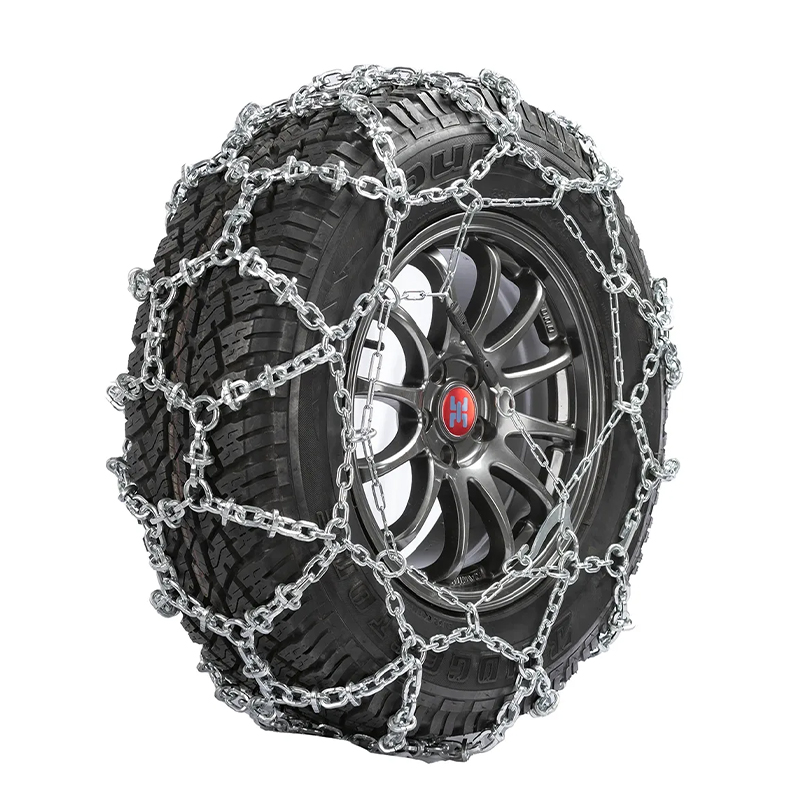
Diamond-pattern tire chains use a crisscross design that forms a network of interconnected links covering the tire’s surface more evenly.
Key characteristics:
- Continuous ground contact
- Improved lateral stability
- Smoother ride compared to ladder-style chains
Applications:
These tire chains for trucks are widely used in mountainous regions and for long-haul winter transportation. They perform well during braking, acceleration, and cornering, making them suitable for varied terrain.
Limitations:
The more complex structure increases production cost and installation time. However, many fleets consider this a reasonable trade-off for enhanced safety.
Square Link Tire Chains
Square link tire chains are defined by the shape of their individual chain links. Instead of round links, square links present sharp edges that bite into snow and ice.
Key characteristics:
- Superior grip on ice
- Enhanced durability under heavy loads
- Longer service life compared to round link chains
Applications:
Square link tire chains for trucks are commonly used in extreme winter conditions, forestry operations, mining transport, and off-road logistics. They are especially effective for trucks operating on packed snow or frozen surfaces.
Limitations:
The aggressive traction can increase wear on road surfaces and tires if used on bare pavement. Proper usage is essential to avoid unnecessary damage.
V-Bar Tire Chains
V-bar tire chains incorporate small V-shaped metal studs welded onto each chain link, significantly increasing penetration into ice.
Key characteristics:
- Maximum traction on glare ice
- Exceptional performance on steep, icy grades
- Designed for severe winter environments
Applications:
These tire chains for trucks are often used in regions with prolonged icy conditions, such as high-altitude routes and remote northern areas. They are particularly valuable for emergency vehicles and heavy-haul operations.
Limitations:
V-bar chains can be noisy and cause accelerated wear on tires and road surfaces. Their use is typically restricted to conditions where extreme traction is necessary.
Studded Tire Chains
Studded tire chains feature integrated metal studs distributed across the chain structure. While similar to V-bar designs, studded chains offer a more uniform distribution of traction points.
Key characteristics:
- Balanced traction across the tire
- Improved braking efficiency
- Stable performance on mixed snow and ice
Applications:
Studded tire chains for trucks are used in areas with variable winter conditions, where roads alternate between snow, ice, and compacted surfaces.
Limitations:
Studded designs may be subject to regulatory restrictions in certain regions due to road wear concerns.
Automatic and Semi-Automatic Tire Chain Systems
Automatic tire chain systems represent a technological evolution in traction control. Instead of manually installing chains, these systems deploy a rotating chain mechanism beneath the tire at the push of a button.
Key characteristics:
- Rapid activation without stopping
- Improved driver safety
- Reduced downtime during chain control
Applications:
These tire chains for trucks are commonly used in emergency response, municipal services, and time-sensitive logistics operations.
Limitations:
Higher initial cost and more complex maintenance requirements compared to traditional chains.
Material Considerations in Tire Chains for Trucks
Material selection plays a critical role in determining performance, durability, and cost.
| Material Type | Key Advantages | Typical Applications |
|---|---|---|
| Alloy Steel | High strength and wear resistance | Heavy-duty trucking |
| Case-Hardened Steel | Improved surface hardness | Long-haul winter transport |
| Heat-Treated Steel | Balanced durability and flexibility | Mixed terrain operations |
Advanced heat treatment and surface finishing processes further enhance corrosion resistance, extending service life in wet and salty environments.
Selecting the Right Tire Chains for Trucks
Choosing the appropriate tire chains for trucks involves evaluating multiple factors:
Operating environment: snow depth, ice presence, road grade
Vehicle configuration: axle count, tire size, load capacity
Regulatory requirements: regional chain laws and restrictions
Operational frequency: occasional use versus continuous winter operation
Fleet managers increasingly adopt a segmented approach, maintaining different types of tire chains for trucks within the same fleet to address diverse routes and conditions.
Installation, Maintenance, and Safety Considerations
Proper installation is critical for maximizing the effectiveness of tire chains for trucks. Incorrect tension or alignment can lead to chain breakage, tire damage, and safety hazards.
Routine maintenance includes:
- Inspecting links for wear and cracks
- Checking tensioning components
- Cleaning and drying chains after use
Training drivers on correct installation and removal procedures significantly reduces downtime and extends product lifespan.
Conclusion
Tire chains for trucks remain a foundational component of winter road safety and operational continuity. From traditional ladder-style chains to advanced automatic systems, each type serves a specific purpose shaped by terrain, climate, and operational demands. Understanding the structural differences, material properties, and application scenarios enables industry professionals to select solutions that balance safety, efficiency, and cost.
FAQ
1. Are tire chains for trucks suitable for all winter conditions?
Tire chains are most effective on snow and ice. They should be removed when driving on dry pavement to prevent damage to tires and road surfaces.
2. How often should tire chains for trucks be inspected?
Chains should be inspected before and after each use, with periodic checks during extended operations to identify wear or damage.
3. Can tire chains for trucks be reused across seasons?
Yes, with proper maintenance and storage, high-quality tire chains can be used for multiple winter seasons.
4. Do tire chains for trucks affect fuel efficiency?
When installed, tire chains can slightly increase rolling resistance. However, their impact on fuel efficiency is generally minimal compared to the safety benefits.