English
 Español
 Deutsch
 日本語
日本語In the world of logistics, construction, and everyday hauling, the difference between a secure shipment and a roadside disaster often comes down to one simple tool: the ratchet strap. While ropes, bungee cords, and cam buckle straps have their place, none offer the same combination of controlled tension, holding power, and reliability for heavy loads as ratchet straps. Understanding why they are indispensable requires looking at the physics of load movement, the consequences of inadequate securement, and the specific design features that make ratchet tie down systems superior.
The Hidden Forces Acting on a Load
When a vehicle accelerates, brakes, or turns, the cargo inside does not remain stationary. Even a seemingly well-packed truck bed experiences multiple forces simultaneously. Forward inertia during sudden braking can multiply a load’s effective weight by several times. A 500 kg pallet can exert over 2000 kg of forward force in an emergency stop. Sideways forces from cornering and vertical shocks from uneven roads add further complexity.
Without proper restraint, heavy items shift, tip, or even become projectiles. This is not merely a matter of damaged goods; it is a serious safety hazard for drivers and others on the road. Government transportation agencies worldwide mandate load securement practices, often specifying minimum working load limits (WLL) and assembly requirements. Ratchet straps, when selected and used correctly, meet these stringent demands.
How Ratchet Straps Differ from Other Tie-Downs
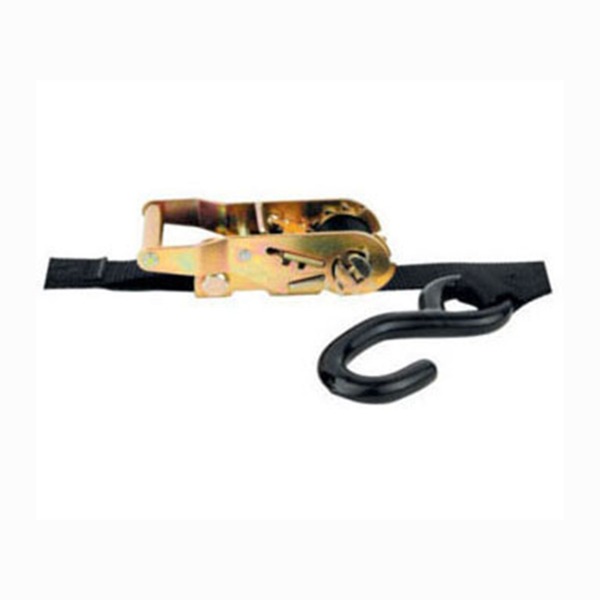
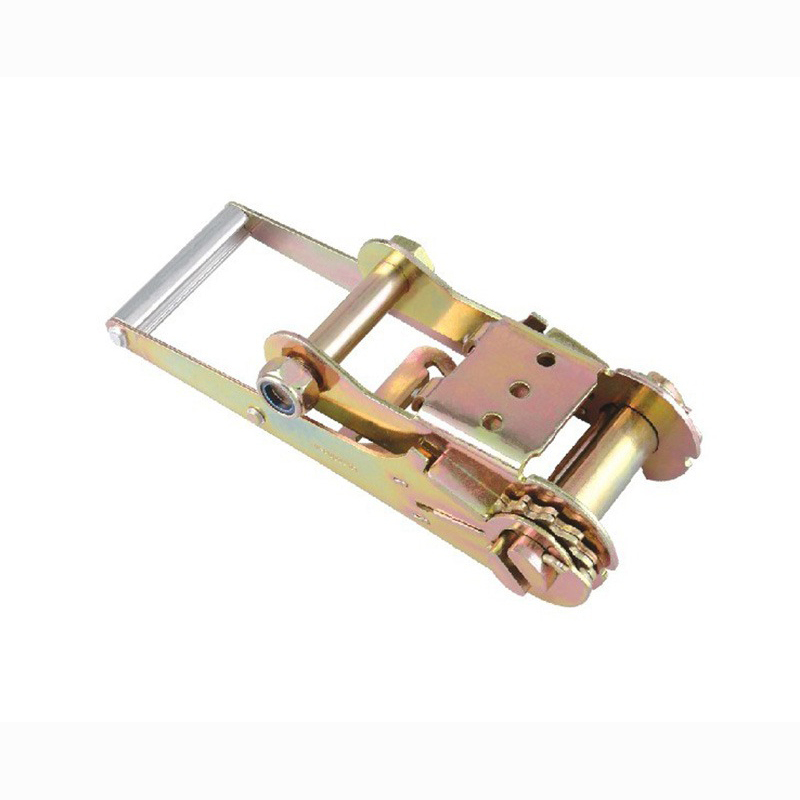
Many people confuse ratchet straps with lighter-duty alternatives. A true ratchet strap consists of three key components: a durable polyester webbing, a ratcheting mechanism with a handle, and end fittings such as flat hooks, wire hooks, or loop ends. The ratchet mechanism allows the user to incrementally tighten the webbing, achieving far higher tension than human pulling strength alone could produce.
Below is a comparison of common tie-down types and their suitability for heavy loads:
| Tie-Down Type | Typical Breaking Strength | Tension Control | Best Use Case |
|---|---|---|---|
| Polypropylene rope | Low to medium | Poor | Light, bundled items |
| Cam buckle strap | Low to medium | Fair | Lighter cargo, indoor use |
| Bungee cord | Very low | None | Securing tarps, light objects |
| Ratchet strap | High to very high | Excellent | Heavy machinery, pallets, vehicles |
The table clearly shows that when strength and precise tension are non-negotiable, ratchet tie down systems are the only practical choice for heavy loads.
The Mechanical Advantage of Ratchet Tie Down Mechanisms
One of the most overlooked engineering advantages of a ratchet tie down is its mechanical advantage. A typical ratchet mechanism provides a gear ratio that multiplies the user’s input force. With modest hand pressure, an operator can apply hundreds of kilograms of tension along the webbing. This tension presses the load downward into the vehicle bed and creates friction, further resisting movement.
Moreover, the ratchet’s locking pawl prevents the webbing from loosening under vibration. Unlike a cam buckle, which can gradually release with cyclic shaking, a properly engaged ratchet tie down stays tight. Once the handle is closed and locked, the only way to release tension is to manually open the pawl—something that cannot happen accidentally in transit.
Key Scenarios Where Ratchet Straps Are Mandatory
Not every load requires a ratchet strap. But in the following situations, using anything less is risky at best and illegal at worst.
Heavy machinery and equipment
Bulldozers, forklifts, generators, and industrial presses have high centers of gravity and dense mass. Their momentum during sudden stops is extreme. Ratchet straps with high WLL ratings (often 500 kg to 5000 kg per strap) are standard.
Coiled or cylindrical goods
Steel coils, pipes, and cable reels want to roll. Standard friction alone cannot stop them. Ratchet straps cinched around multiple anchor points prevent rotation and longitudinal movement.
Vehicles on trailers
Cars, motorcycles, and ATVs need four-point restraint systems. Ratchet tie down straps attached to the frame or suspension provide the necessary downward and forward restraint without damaging the vehicle.
Oversized or irregular loads
Construction forms, timber bundles, and prefabricated panels often lack flat, stable surfaces. Ratchet straps adapt to odd shapes because the webbing conforms to contours, and the high tension holds everything in compression.
The Consequences of Failing to Use Ratchet Straps
Industry data (without citing specific companies) consistently show that unsecured or under-secured cargo is a leading cause of truck-related debris accidents. Even a 20 kg object falling off a moving truck at highway speed can shatter a following vehicle’s windshield or cause a multi-car pileup.
Financially, the costs are severe. Damaged goods, vehicle repairs, road cleanup fees, legal liability, and increased insurance premiums quickly dwarf the modest price of quality ratchet straps. In regulated transport sectors, inspectors routinely check for compliant securement. Failure can result in out-of-service orders, fines, and damaged safety ratings.
From a reputational standpoint, no logistics provider or construction company wants to be known for spilled loads on highways. Consistent use of proper ratchet tie down equipment signals professionalism and respect for public safety.
Choosing the Right Ratchet Strap for the Job
Not all ratchet straps are created equal. Selecting the correct type involves understanding several specifications.
Working load limit (WLL)
This is the maximum force the strap is designed to handle in normal use. By international standards (such as EN 12195-2 or WSTDA), the WLL is typically one-third of the breaking strength. For heavy loads, a WLL of 1000 kg or more per strap is common. Multiple straps are used in combination to secure a single load.
Webbing material and width
Polyester is the industry standard because it resists UV degradation, has minimal stretch, and maintains strength when wet. Nylon absorbs moisture and loses up to 15% of its strength. Widths from 25 mm to 100 mm correspond to higher WLLs.
End fittings
Flat hooks work for most rub rails and stake pockets. Wire hooks fit smaller holes. Loop ends allow custom configurations or attachment to chains. For delicate surfaces, protected or coated hooks prevent scratching.
Ratchet finish
Zinc-plated or painted ratchets are fine for dry, occasional use. Stainless steel or epoxy-coated mechanisms are necessary for marine environments, chemical plants, or frequent outdoor exposure.
Step-by-Step: How to Properly Use Ratchet Tie Down Straps
Even the best ratchet tie down fails if used incorrectly. Follow this sequence for safe, legal securement.
- Inspect the strap – Check for cuts, abrasions, fraying, broken stitching, or rusted ratchet components. Discard any damaged strap immediately.
- Position the load – Center the cargo against the vehicle’s headboard or front wall. Use chocks or dunnage to prevent forward shifting.
- Attach the fixed end – Connect the non-ratcheting end’s hook to a rated anchor point on the vehicle. The anchor must be stronger than the strap’s WLL.
- Thread the webbing – Pass the loose webbing through the ratchet slot, pull out slack, then engage the ratchet handle.
- Apply tension – Pump the handle until the webbing is tight and the load no longer moves when pushed by hand. Avoid over-tightening to the point of deforming the cargo.
- Lock and store excess – Close the handle flush against the ratchet body. Secure loose webbing by wrapping it around the handle or using a strap keeper.
- Check during transit – Stop after the first few kilometers to re-tension if needed. Vibration can settle the load and create slack.
Common Mistakes to Avoid
Even experienced users make errors. Here are frequent pitfalls with ratchet tie down systems.
- Using damaged webbing – A small cut reduces breaking strength by 50% or more. Never hide damage with tape or ignore frayed edges.
- Twisted webbing – Twists reduce contact area with the load and lower effective tension. Always lay the strap flat.
- Anchoring to unsafe points – Plastic trim, fuel lines, brake cables, or thin sheet metal are not anchors. Use only manufacturer-designated tie-down points.
- Insufficient number of straps – Regulations typically require at least two straps for most heavy loads. Longer or heavier items need more.
- Ignoring edge protection – Sharp metal corners cut webbing easily. Use corner protectors or old carpet pieces.
- Using the ratchet as a winch – Ratchet straps are for tensioning, not pulling vehicles out of ditches. That misuse destroys the mechanism.
Environmental and Maintenance Considerations
Ratchet straps are not lifetime tools. Polyester webbing degrades slowly under UV light. After two to three years of regular outdoor use, strength diminishes. Store straps in a cool, dry place away from direct sunlight and chemicals. If a strap is used in saltwater or corrosive environments, rinse with fresh water and dry thoroughly.
Lubricate the ratchet mechanism annually with a light oil or dry lubricant. Sand or grit inside the ratchet can cause skipping or failure to hold tension. Test each strap’s locking function before every major use.
Frequently Asked Questions (FAQ)
Q: Can I use ratchet straps to secure a load on a flatbed trailer without side rails?
A: Yes. Use anchor points embedded in the trailer floor or along the rub rail. For side-less trailers, you may need to cross the straps over the load at angles to prevent sideways movement. Always follow the one-strap-per-10-feet rule for length.
Q: How many ratchet tie down straps do I need for a 2000 kg machine?
A: The number depends on strap WLL and regulations. If each strap has a WLL of 1000 kg, a minimum of two straps is required to restrain 2000 kg in a forward direction. However, most rules demand additional straps for lateral and rear restraint. Four straps are common for such loads.
Q: Are ratchet straps reusable after being overloaded?
A: No. Any strap that has been subjected to a sudden shock load, visible damage, or load exceeding its WLL should be destroyed immediately. Cut the webbing into short pieces to prevent accidental reuse. Safety is not worth the risk.
Q: What is the difference between ratchet straps and cargo bars?
A: Cargo bars (load locks) press outward against side walls and are good for light to medium palletized goods. They do not provide downward tension or direct forward restraint. Ratchet straps are superior for heavy, dense, or potentially shifting loads.
Q: Can ratchet straps be used for lifting?
A: No. Lifting slings are designed with higher safety factors (typically 5:1 or 7:1) and different certifications. Ratchet straps are for securing cargo in transport, not overhead lifting. Using them for lifting risks catastrophic failure.
Conclusion: The Non-Negotiable Role of Ratchet Straps
Heavy load transportation is an environment of unforgiving forces. Gravity, inertia, vibration, and wind combine to attack even well-placed cargo. Ratchet straps provide the controlled, sustained, and adjustable tension that passive methods cannot achieve. Their mechanical advantage turns human strength into industrial-grade restraint. Their robust locking mechanisms hold fast through thousands of kilometers of rough roads.
For fleet managers, construction supervisors, and independent haulers, investing in high-quality ratchet tie down equipment is not an expense—it is a cornerstone of operational safety. No amount of careful driving can compensate for an unsecured load. By understanding the forces involved, selecting the right straps, and using them correctly every time, professionals protect themselves, their cargo, and everyone sharing the road.
Make ratchet straps the standard, not the exception. When the question is “Is this load secure?” the only acceptable answer comes from a properly tensioned, correctly anchored ratchet tie down.