English
 Español
 Deutsch
 日本語
Heavy duty chains are engineered components, not commodity hardware. They are manufactured from controlled steel grades, heat-treated, proof-tested, and marked so that a user can determine safe working capacity from the link or the attached tag. The difference between a chain that performs reliably and one that fails under load is rarely visible to the naked eye; it lies in metallurgy, heat treatment, and the discipline applied during production. Every year, failures in incorrectly specified chains cause equipment damage and injuries. Most of these failures are avoidable with a disciplined approach to grade selection and inspection. This guide explains what defines a heavy duty chain, how strength grades are classified in different markets, and how to select, inspect, and maintain chains for lifting, towing, and cargo control. It is written for purchasing engineers, maintenance teams, riggers, and operators who need a practical reference rather than a marketing summary.
If you are not yet familiar with basic chain terminology, our heavy duty steel chain guide covers the fundamentals of chain construction and terminology.
What Defines a Heavy Duty Chain?
A chain earns the heavy duty label through a combination of material selection, heat treatment, and quality control. Four factors matter most.
- Steel grade. Chains rated for overhead lifting are made from alloy steel containing chromium and molybdenum. Lower grades use qualified carbon steel that is strong but not accepted for lifting loads above personnel.
- Heat treatment. After welding, the chain is hardened and tempered to raise yield strength and impact toughness. The heat treatment profile determines whether a chain can absorb shock loading or will fracture abruptly.
- Proof testing. Samples from each production batch are pulled to a specified load to verify strength and elongation. Proof loading does not make a chain stronger; it verifies that the batch meets the specification.
- Traceable marking. Lift-rated chain carries embossed grade numbers on alternating links plus a tag showing working load limit, batch code, and the applicable standard.
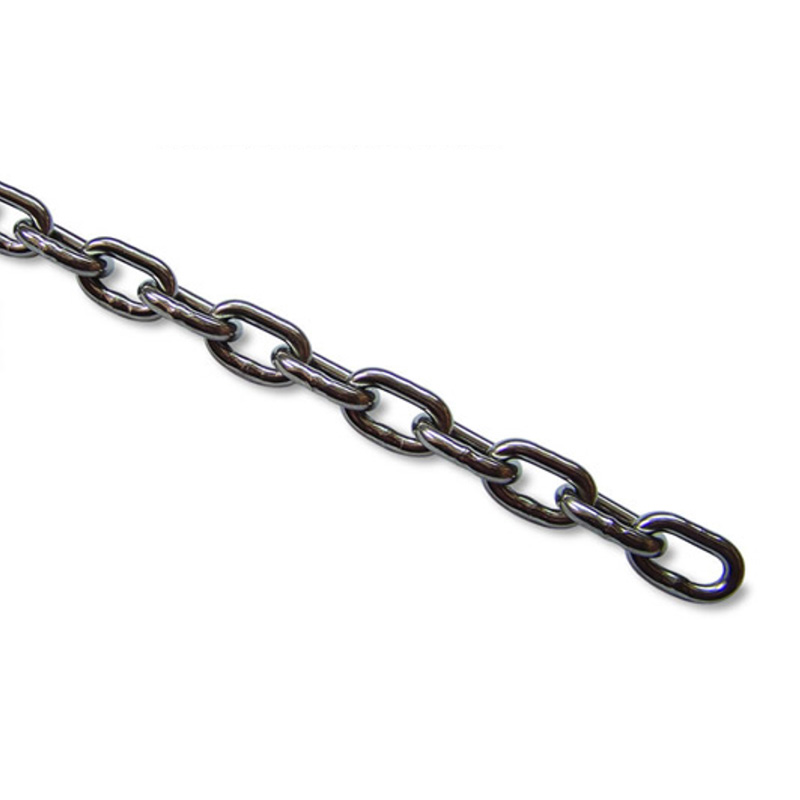
Link geometry also matters. The ratio of link pitch to wire diameter affects flexibility, wear against hooks and sprockets, and resistance to snagging. Short-link chains are stiffer and better suited to lifting; longer link chains bend more easily and are common in towing and tie-down applications.
Shock load resistance is a function of both tensile strength and ductility. An overly hard chain can stretch very little but snap without warning; a properly tempered chain will stretch and show visible deformation before fracture. For this reason, reputable manufacturers publish minimum elongation values, and users should treat unusually high hardness readings as a warning sign.
Temperature limits are another defining property. Alloy chains lose strength when heated. As a general rule, working load limits are reduced when service temperature exceeds 200 C, and most alloy chains are not permitted above 400 C. Extremely low temperatures require specially certified materials because standard carbon steel may lose ductility.
Chain Grades and International Standards
Chain grades communicate the minimum breaking load, working load limit, and toughness of a chain from a single marking. The table summarizes the grades most commonly used in lifting, towing, and cargo control.
| Grade | Material | Working load limit | Typical use |
|---|---|---|---|
| G30 | Low-carbon steel | MBL / 4 | General pulling and binding |
| G43 | Carbon steel | MBL / 3.5 | Logging and agricultural tie-down |
| G70 | High-strength carbon | MBL / 3.5 | Transport and trailer securement |
| G80 | Alloy steel | MBL / 4 | Overhead lifting and rigging |
| G100 | Alloy steel | MBL / 4 | High-capacity lifting and compact slings |
The most influential specification in North America is published by the National Association of Chain Manufacturers. European lifting chain follows EN 818, and general-purpose chain follows DIN series such as DIN 5685 and DIN 766. Australian standard AS 2321 governs many lifting and towing chains in that region. Although the marking schemes differ, the grade philosophy is the same: a numeric code stamped on the link tells the user what strength the chain was built and tested to.
Grade symbols are not interchangeable. A chain marked 80 cannot be assumed to equal a chain marked 100 even at the same wire diameter, because the minimum breaking load and material toughness are different. Always verify the grade against the supplier certificate before mixing chains from different sources.
How to Read Heavy Duty Chain Markings
Every lift-grade chain has identification embossed on the links, usually on every other link. Grade 80 chain is marked with the number 80; grade 100 chain is marked with 100. The attached tag provides additional data: working load limit for straight pull, nominal link size, batch number, manufacturer symbol, and the standard number.
The tag and the embossing must agree. If the tag is damaged or the embossing is worn, the chain cannot be positively identified and should be removed from service until it is re-certified by the supplier.
- Nominal size refers to the wire diameter in millimeters, for example 10 mm or 13 mm.
- Working load limit is the maximum force permitted in a straight pull under normal service.
- Batch numbers allow traceability to the heat treatment furnace and proof test record.
When working with international suppliers, the certificate is the most reliable source of identity. A certificate of conformance confirms the grade, standard, test results, and the manufacturer quality system.
How to Select the Right Heavy Duty Chain
Selecting the correct chain balances strength, weight, cost, hardware fit, and environmental resistance. Work through the following questions in order.
- How will the chain be loaded? Overhead lifting requires G80 or G100 alloy. Towing and tie-down applications can use G70 transport chain or G43 binder chain at a lower cost.
- What is the maximum load? The working load limit must equal or exceed the highest force the chain will see, including shock loads from sudden starts or stops.
- Will the chain fit the hardware? Hooks, clevises, sheaves, and sprockets have fixed openings. Check link width and pitch against the hardware dimensions before ordering.
- What is the environment? Marine and chemical exposure favors stainless or hot-dip galvanized chain. Abrasive environments call for thicker wire or a tougher grade.
- What documentation is required? Many factories require a test certificate for any chain used in lifting. Confirm this before purchase, not after.
Rule of thumb: choose a chain whose working load limit is at least two times the expected maximum static load whenever shock loading is possible. This margin protects against dynamic loads and minor misalignment.
For most lifting and rigging tasks, G80 alloy chain is the industry default. For applications where the rigger must carry the chain by hand, G100 offers a higher strength-to-weight ratio, so a smaller-diameter chain can replace a heavier G80 chain for the same working load.
 G80 Alloy Chain for Lifting and Rigging ApplicationsThis alloy chain is the industry default for lifting tasks, offering reliable strength for hand-carried rigging. It appears here as a baseline for comparing higher-grade options like G100.View Product →
How Heavy Duty Chain Is Made and Heat-Treated
The manufacturing sequence explains why heavy duty chain costs more than commodity chain, and why consistency varies between suppliers. The process begins with drawn steel rod that is cut to precise lengths, then formed into open links.
After forming, the link ends are joined by flash welding. The weld is the most vulnerable point of a chain, so the welding operation must produce a full cross-section weld without undercut or porosity. Modern lines use resistance welding with close control of current, pressure, and cycle time.
Heat treatment is the defining step. The chain passes through a continuous furnace, is heated above the transformation temperature, quenched in oil or water, and then tempered to restore ductility. Correct heat treatment produces a structure that combines high tensile strength with enough elongation to warn the operator before failure.
After heat treatment, the chain is proof loaded on a hydraulic press. This step screens out weak links and seats the link geometry. Final operations include visual inspection, pitch measurement, surface finishing such as galvanizing or painting, and grade marking.
The choice between galvanized, painted, or plain finished chain depends on the operating environment. Zinc coatings protect against general atmospheric corrosion but wear away under heavy rubbing. Painted finishes are mainly cosmetic on lifting chain. When severe corrosion is expected, stainless steel is the only reliable solution.
Where Heavy Duty Chains Are Used
Lifting and rigging
Chain slings made from G80 or G100 alloy are common in construction, workshops, and shipyards. They resist abrasion and high temperature better than synthetic slings, and they can be adjusted in length using hooks, master links, and shortening clutches.
 Chain Sling Assemblies with Hooks and Master LinksChain slings resist abrasion and high temperatures, making them suitable for construction and shipyards. This product is highlighted alongside load binders for cargo securement systems.View Product →
Transport and cargo control
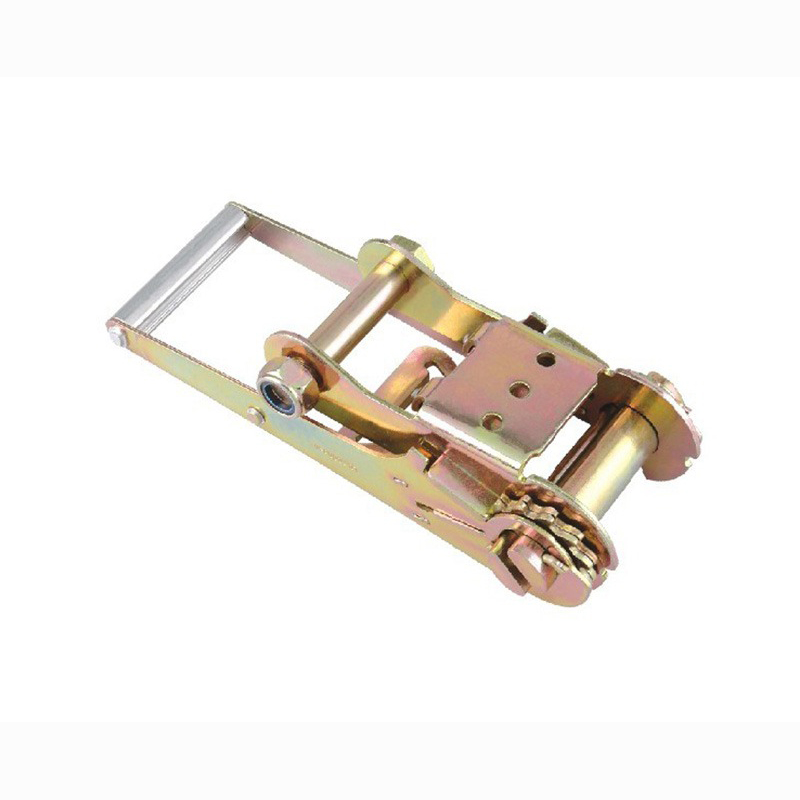
G70 transport chains and G43 binder chains are paired with load binders and ratchet tie-downs to secure cargo on flatbed trailers, in containers, and on rail cars. The chain provides the strength and the binder provides the tension; the combination must always be rated so that the weakest element in the system carries the full working load.
Forestry, mining, and agriculture
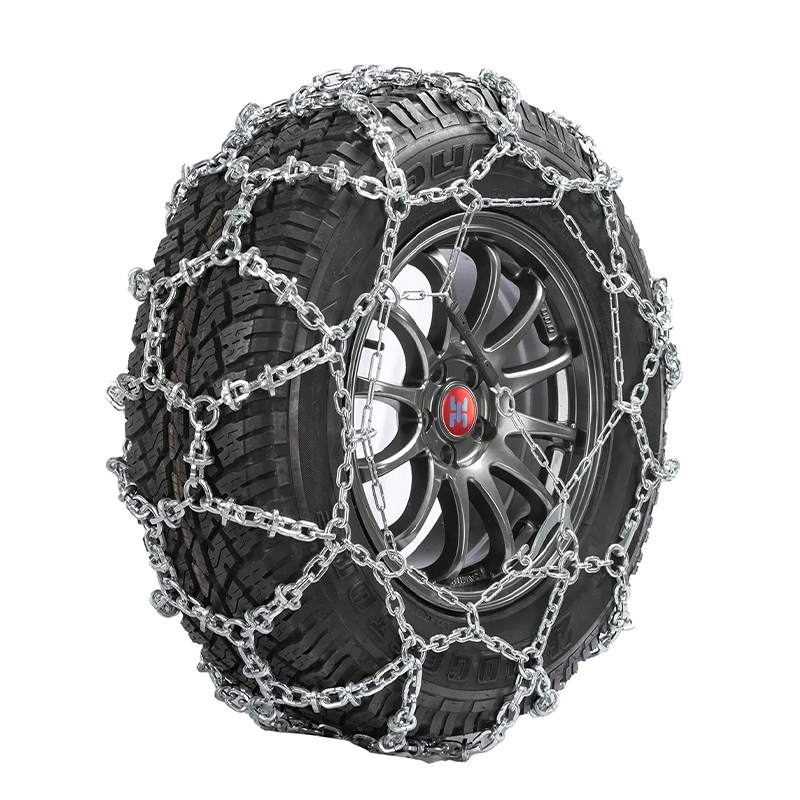
Tire protection chains are fitted on loaders and haul trucks to extend tire life on rough ground. Forestry chains, tractor chains, and agricultural binder chains are built to absorb impact and resist abrasion from soil, rock, and timber. Construction sites also rely on heavy duty chain for hoisting equipment, securing rebar bundles, and anchoring temporary structures. The chain must be protected from welding sparks and cutting torches because heat damage is not always visible.
Marine and material handling
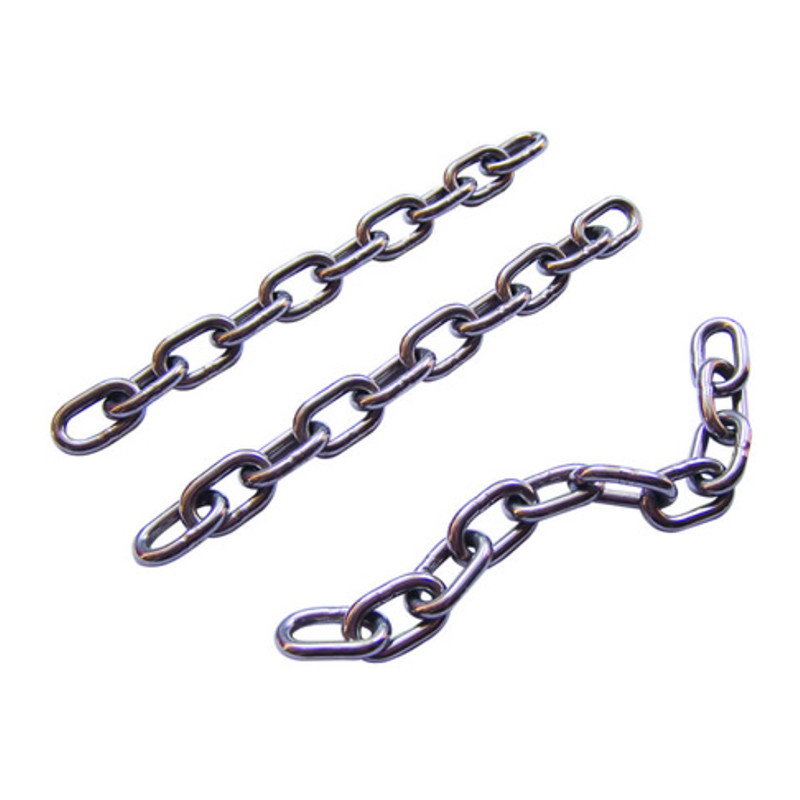
Anchor chains, mooring chains, and forklift chains are specialized heavy duty products. Forklift chains flex around sprockets under constant load cycles, so they demand tight manufacturing tolerances. Stainless steel heavy duty chain appears in food processing, offshore, and other corrosive environments where carbon steel would fail quickly.
For a complete listing of welded chain types, grades, and related lifting hardware, see the main product catalog.
Working Load Limits, Safety Factors, and Inspection
Two strength values define a chain: the minimum breaking load, which is the force at which the chain is expected to fracture, and the working load limit, which is the maximum safe force under normal service. The ratio between them is the safety factor.
Typical design safety factors: G30, G80, and G100 chains are rated at 4 to 1; G43 and G70 chains are rated at 3.5 to 1.
What to inspect
- Elongation. Measure a 10-link section. If it has stretched more than roughly 3 percent, remove the chain from service.
- Cracks and nicks. Surface cracks at the weld or on the link crown are immediate rejection criteria.
- Corrosion. Deep pitting can reduce the effective cross-section more than it appears on the surface.
- Wear. Use a caliper to measure link wire diameter. A reduction beyond 5 percent is grounds for replacement.
- Deformation. Bent, twisted, or stretched links indicate overload and require replacement of the affected section or the entire chain.
Inspection frequency
| Service condition | Inspection requirement |
|---|---|
| Every use | Visual check for damage, wear, and deformation |
| Continuous heavy duty | Documented inspection every 3 months |
| Intermittent light duty | Documented inspection every 12 months |
| After any overload or impact | Full inspection before reuse |
Inspection records should include the chain identification, inspection date, inspector name, and measurements. A chain that has been removed from service should be destroyed or permanently marked to prevent accidental reuse.
 G100 Alloy Chain for High-Strength LiftingG100 provides a higher strength-to-weight ratio than G80, allowing a lighter chain for the same working load. This is useful for manual handling and overhead lifting applications.View Product →
Frequently Asked Questions
Q1: What is the difference between G70 and G80 chain?
G70 is a high-strength carbon steel chain designed for transport and tie-down. G80 is an alloy steel chain with a higher minimum breaking load, better toughness, and formal acceptance for overhead lifting in most jurisdictions.
Q2: How do I find the working load limit of a chain?
Read the tag attached to the chain or the embossed marking on the links. The working load limit is also published in supplier tables for each grade and nominal size. If the identification is missing, do not estimate; return the chain to the supplier for re-certification.
Q3: Can transport chain be used for overhead lifting?
No. Transport chain is not certified for lifting loads over personnel. Only alloy lifting chain marked G80 or G100 and certified to the relevant standard should be used in overhead applications.
Q4: How often should heavy duty chain be inspected?
Perform a visual check before every use. Perform a documented inspection at least annually, and more often in continuous heavy service. Any chain that has been overloaded or impacted must be inspected immediately.
Q5: What does proof tested mean?
Proof testing subjects a representative chain sample to a load above the working load limit to verify that it meets the specified strength without permanent deformation. It is a factory quality-control step, not a field procedure.